The roll-out of free library apps for our patrons continues at break-neck speed! We recently purchased our first audio book collection of 108 fiction titles, with hopes of continued growth! For years our library researched the pros and cons of adding audio books to a college preparatory environment, and, in the end, decided that the advantages to our readers was just too good to pass up!
The collection contains titles based on our most popular book requests and fiction searches in Destiny Quest. The ability to gather this critical data has enabled us to build a digital media collection that our students will read for fun and enjoyment, not just what we "think" they should be reading! It is my belief as a librarian that while the classics are wonderful, and required summer reading titles a must, we still need to deliver popular titles and topics that make our readers want to read, not simply have to read! Our school web page has a brief instructional hand-out on the 3 new apps, along with detailed log in instructions for students and faculty.
Both the audio and ebook collection will continue to grow and change to meet the needs of our students. Happy summer reading from the library at Maclay School!
The postings on this site are my own and do not necessarily represent the position, strategies, or opinions of Maclay School.
Wednesday, May 16, 2012


Tuesday, April 24, 2012
Positive Circulation Results from Fixed Schedule Conversion
A recommendation of the 2011 accreditation library review committee was to switch the Lower School from a fixed to flexible schedule. A flexible schedule was created for lower school students, modeled after the MS/US schedules. Research assignments were scheduled to meet the needs of each class, facilitated by the Librarian. Weekly check out times were scheduled with the individual teacher, who also accompanied their class. There was no special area grading criteria/designation. The only Lower School grade to continue with a weekly graded skill was 5th grade, at the request of the Librarian.
The library evaluated the first year of flex schedule by using several data sets, based on the dates of August 2011 through April 20, 2012:
· Scheduled skills and check out calendars
· Individual class research scheduling
· Grade-level circulation statistics
· Patron library material circulation statistics by homeroom for this year and the previous/fixed academic year
· From August 2011 through April 20, 2012, a LS teacher had the opportunity to bring their classroom for checkout at least 27 times.
· During this same time period, the opportunity for additional research, library, and computer time was available at least 3 days a week.
· Skills sequences were initiated by the library 9 times for each homeroom.
Results of the first year of Flex Scheduling are:
1. LS circulation was up overall by 14%.
2. The greatest increase was Kindergarten, up from 155 books to 1142, or 637%.
3. Both 3rd and 4th grade circulation was down; 3rd by 38% and 4th grade by 24%. These classes had for the most part elected not to bring their class for check out but send students on passes when the student initiated the visit. There was a marked decreased in the amount of opportunity these students were able to come to the library.
4. Of the library skills sequences initiated by the library, all Kindergarten through 2nd grade came 7 times, 3rd grade averaged 5/6, and 4th grade 7 times.
Observations:
Several factors contributed to increased circulation: open-door access for students throughout the school day, teacher assistance in selection of books appropriate for students’ reading abilities, and new library policies that favored more checkout privileges. While it was invaluable to come and check out with their teacher as a class, when students came in small groups throughout the day they were able to receive more hands-on assistance from a smaller library staff. This was a bonus for eager readers who enjoyed visiting the library. Thus, teachers were encouraged to schedule a check out time at least once a week. Students in older grades should have had even more flexibility and access. However, this was not the case. Teachers in 3rd and 4th grade did not utilize the weekly check out, and tended not to send their students in small groups on a regular basis, either. Based on these results, the library will work to increase circulation and access to the grades that did not visit as often.
Friday, April 6, 2012
Exciting Mobile Changes to our Library:)
This spring I finally made the move, via our Follett server, to switch my Follett eBooks to the Follett Shelf feature. At first I was hesistant, as we had already taught our students to read the eBooks on Destiny Quest. However, I had not set up actual check out/download privileges for our patrons for a multitude of reasons. As our digital collection grew, I became more interested in Follett Shelf as an alternative. And, once Follett created the free mobile apps, Destiny Quest and Follett Digital Reader, I knew it was time!
The first advantage was easy; Follett Shelf doesn't cost a dime for Follett server patrons! Second, the mobile app allows patrons to check out books on the iPhones, iPads, and Droid tablets. That constitutes the majority of our patrons! So, we made the switch and launched an email promotional campaign using Constant Contact. We began a library skills set for elementary students on using the app. I set up all student and faculty accounts myself, to make their user log ins/passwords as simple as possible. My top middle and high school readers, who can never get enough books, I am targeting for individualized training.
During this transition, the library was hosting a readathon fundraiser. I had my heart set on ordering more eBooks for the digital reader. And then, bingo! Follett announced the availablility of a new digital resource, Catalist Digital downloadable audio books! I have been pricing out downloadable audio for my students for years, but was always intimidated by the costs. I quickly purchased the first 100 or so K-12 fiction audio titles, am having them added to Follett Shelf, and we are in the audio book business at our school! The readathon fundraiser allowed me the flexibility of making the purchase at the end of the school year, when library funds are usually low, to allow for summer check out at home.
All of these exciting changes have increased patron services at our school. More and more, our 24/7 hosted services are keeping our library vital and integrated in the lives of our students and faculty members. Exciting times, indeed!
The first advantage was easy; Follett Shelf doesn't cost a dime for Follett server patrons! Second, the mobile app allows patrons to check out books on the iPhones, iPads, and Droid tablets. That constitutes the majority of our patrons! So, we made the switch and launched an email promotional campaign using Constant Contact. We began a library skills set for elementary students on using the app. I set up all student and faculty accounts myself, to make their user log ins/passwords as simple as possible. My top middle and high school readers, who can never get enough books, I am targeting for individualized training.
During this transition, the library was hosting a readathon fundraiser. I had my heart set on ordering more eBooks for the digital reader. And then, bingo! Follett announced the availablility of a new digital resource, Catalist Digital downloadable audio books! I have been pricing out downloadable audio for my students for years, but was always intimidated by the costs. I quickly purchased the first 100 or so K-12 fiction audio titles, am having them added to Follett Shelf, and we are in the audio book business at our school! The readathon fundraiser allowed me the flexibility of making the purchase at the end of the school year, when library funds are usually low, to allow for summer check out at home.
All of these exciting changes have increased patron services at our school. More and more, our 24/7 hosted services are keeping our library vital and integrated in the lives of our students and faculty members. Exciting times, indeed!
Monday, January 9, 2012
Revitalize in 2012:)
What a successful first semester! The library waded into the flex-scheduling pool with much success and little adjustment. The adjustment was more on the part of the library staff than the students and teachers. This bodes well for services delivery. We hosted a parent workshop on reading resources available at our school for emerging readers with great success and turnout. We are prepared for our school accredidation process in February of 2012, and we have learned to adjust our workload with fewer employees without losing any services.
Perhaps the most exciting new venture was the professional development course held for faculty in the fall; Web 2.0 Collaboration and Learning. The teachers who attended jumped right into the exciting world of teaching tools and collaborative resources, and presented projects and lessons well-above my expectations. Participants were surveyed about how they felt about working in a collaborative, project-based environment, and their responses included the following:
We are beginning our 2nd semester with a new group of faculty members tomorrow evening. This group will also contain a few school administrators. I am excited to continue with this new teaching venture. Aside from learning so much from the teachers involved in the class, it has also opened up more communication between them and the library!
Happy New Year, and more to come as we grow and emerge at our school library:)
Perhaps the most exciting new venture was the professional development course held for faculty in the fall; Web 2.0 Collaboration and Learning. The teachers who attended jumped right into the exciting world of teaching tools and collaborative resources, and presented projects and lessons well-above my expectations. Participants were surveyed about how they felt about working in a collaborative, project-based environment, and their responses included the following:
- It was nice not having the pressure of a traditional class/course environment.
- The way we did this course was perfect because we learned so much from each other. It takes a lot of trial and error and discussion with others.
- It was great working in a collaborative environment where everyone was working toward the same goal, but everyone was willing to help others.
We are beginning our 2nd semester with a new group of faculty members tomorrow evening. This group will also contain a few school administrators. I am excited to continue with this new teaching venture. Aside from learning so much from the teachers involved in the class, it has also opened up more communication between them and the library!
Happy New Year, and more to come as we grow and emerge at our school library:)
Monday, October 24, 2011
October Book Reviews for Young Children
We have hundreds of new books, both in print and ebook format, this month in the library! A few of my favorite fiction and nonfiction titles that just arrived, include the ever-popular author/illustrator Eric Carle!


The Artist Who Painted a Blue Horse by Eric Carle
An Amazon Best Books of the Month for October, the book recounts an early influence in Carle’s life. A child paints the world as he sees it; in this case, a blue horse. Discover your own inner artist as you enjoy yet another wonderful book by Eric Carle.
City Lullaby by Marilyn Singer; illustrated by Carll Cneut
The many loud noises in a busy city can’t seem to awaken a sleeping baby, until the soft chirp of a sparrow. Booklist notes that the author writes with “infectious, rhyming poetry.”
Grandma’s Records by Eric Velasquez
Eric spends the summer in Spanish Harlem with his grandmother, where she shares her old records and love of salsa music. If you enjoyed his other book, Grandma’s Gift, be sure to check out this title, too.
My Life in the Wild series by Animal Planet. Cheetah and Penguin by Meredith Costain.
Examines the life cycle, behavior, habitat of popular animals but told in a narrative way. 
Incredible Journeys: Amazing Animal Migrations (Animal Planet) by Dwight Holing
Describes the migrations of different animals around the world, with fold-out charts of their travels and gorgeous pictures. Included are the African wildebeest, the plains zebra, the American monarch butterfly, and Pacific bluefin tunas.
Thursday, October 20, 2011
Mom Knows Best!
Did you know that our library's collection management system, Follett Destiny Quest, allows parents to make important decisions on their child's book selection? Perhaps you have a great young reader but he or she tends to select books a bit too "scary" or too mature in content? Or, your child repeatedly selects books he can't read, and you are frustrated when he returns from the library. Just let our librarian know, and a message can be displayed that only the librarian sees when your child goes to check out books. You can always reach the librarian via phone or email. This way, we can be sure to remain sensitive to the needs and selection criteria for your family. Because, a mom always knows what is best for her child!
Tuesday, October 11, 2011
ALA Position Statement on the Value of Independent Reading in the School Library Program
There are so many things that can influence, good or bad, a child's reading development. Having access to quality materials is one. A library needs to stay up-to-date in its selection of quality, new, and award-winning materials at varying reading and interest levels. At our library, we like to teach our young readers to narrow searches down by "interest level" instead of by "reading level." It is exciting when a young child can read at or above grade-level! However, not all fiction written for a particular grade/reading level is appropriate for the young reader. Thus, we are excited to show them how to narrow their search results using Follett's Destiny Quest.
Other important parts of the reading equation include the modeling of good reading habits at home, spending time with your child reading together, and the opportunity to spend independent time reading books that interest them, and are not necessarily required of them! We foster independent reading opportunities in our library by an open-door/class pass policy. Teachers can send a child in anytime during the school day to read and select materials. We also offer Kindles in our collection for in-house, independent reading opportunities, loaded with age-appropriate titles. After school, young students can come in with a parent to read and check out more books!
The following statement by the American Library Association is based on the Goals 2000 that make literacy important nationally. Your library at Maclay School supports these goals, and seeks through our collection development and library programs to ensure your child gets the best opportunity for them to become life-long readers!
(A portion of the ALA statement)
To become life-long readers, students must have . . .
Other important parts of the reading equation include the modeling of good reading habits at home, spending time with your child reading together, and the opportunity to spend independent time reading books that interest them, and are not necessarily required of them! We foster independent reading opportunities in our library by an open-door/class pass policy. Teachers can send a child in anytime during the school day to read and select materials. We also offer Kindles in our collection for in-house, independent reading opportunities, loaded with age-appropriate titles. After school, young students can come in with a parent to read and check out more books!
The following statement by the American Library Association is based on the Goals 2000 that make literacy important nationally. Your library at Maclay School supports these goals, and seeks through our collection development and library programs to ensure your child gets the best opportunity for them to become life-long readers!
(A portion of the ALA statement)
To become life-long readers, students must have . . .
- access to current, quality, high interest, and extensive collections of books and other print materials in their school libraries, classrooms, and public libraries;
- contact with adults who read regularly and widely and who serve as positive reading role models;
- certified school librarians and classroom teachers who demonstrate their enthusiasm for reading by reading aloud and booktalking;
- time during the school day dedicated to reading for pleasure, information, and exploration;
- opportunities specifically designed to engage young people in reading;
- schools that create an environment where independent reading is valued, promoted, and encouraged; and
- opportunities that involve care givers, parents and other family members in reading.
Thursday, September 29, 2011
Adult Titles: New for the Fall

Game Day: Meet the People Who Make it Happen by Kevin Sylvester
A behind-the-scenes look at the unsung heroes behind the star athletes in the world of sports.

The Notorious Benedict Arnold: A True Story of Adventure, Heroism, and Treachery by Steve Sheinkin
A fresh look at a famous American villian, the author recounts the tactical brillance, heroism, and adventurous nature of Benedict Arnold.

A Nation Within a Nation: Organizing African-American Communities Before the Civil War by John Ernest
Examines the strong community organization, religion, and culture of antebellum slave life. The author argues that the strength of this culture helped to define the 18th century African American living in both the North and South no less than slavery.
MS/US: New YA Novels

Purple Heart by Patricia McCormick
A contemporary suspense novel set in wartime Iraq. Private Matt Duffy awakens in a military hospital and must piece together the puzzle of events in his mind with the conflicting stories his friends are telling him. Tackles the issues of war and heroism.

Erak's Ransom by John Flanagan
Book 7 in The Ranger's Apprentice series. A mission to save their friend Erak leads to new challenges, allies, and foes.
Lower School: New Novels

Wonderstruck: a novel in words & pictures by Brian Selznick
Following up on the success of his Caldecott book The Invention of Hugo Cabret, Selznick uses the same picture-telling format to tell the tale of 2 stories set 50 years apart as young Ben seeks the father he never knew.

Torn by Margaret Peterson Haddix
Book 4 in The Missing series, time-traveler siblings find themselves in the thick of a mutiny on Henry Hudson's ship in 1611.
Lower School: New E Books for the Fall :)

A hippo and kangaroo decide to beat the boredom of winter by staging an elaborate musical.
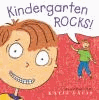
Kindergarten rocks! by Katie Davis
Dexter Dugan thinks he is ready for kindergarten, but what if...? A comforting look at first-day jitters for new students.
Monday, September 26, 2011
9 Things That Happen When You Read (a re-post)
I was so touched by this reading, that I had to re-post. Sometimes we get so caught up in the Web 2.0 world that we forget all we gain from reading a book!This is a re-post from Book Browse: http://www.bookbrowse.com/blogs/editor/index.cfm/2011/9/25/9-Things-That-Happen-When-You-Read
We observe the general scene and follow the narrative. Whether action-filled or more literary, we read all novels the same way: seeking out the meaning and main idea. - We transform words into images in our mind, completing the novel as our imaginations picture what the words are telling us.
- Part of our mind wonders how much is real experience and how much is imagination. "A third dimension of reality slowly begins to emerge within us: the dimension of the complex world of the novel."
- We wonder if the novel depicts reality as we know it. Is this scene realistic, could this actually happen?
- We enjoy the precision of analogies, the power of narrative, the way sentences build upon one another, the music of the prose.
- We make moral judgments about the characters' behavior, and about the novelist for his own moral judgments by way of the characters' actions and their consequences.
- We feel successful when we understand the text, and we come to feel as though it was written just for us.
- Our memory works hard to keep track of all the details, and in a well-constructed novel, everything connects to everything.
- We search for the secret center of the novel, convinced that there is one. We hunt for it like a hunter searches for meaningful signs in the forest.
From Orhan Pamuk's The Naive and the Sentimental Novelist (2009), which originated as a series of six public lectures at Harvard; abbreviated and paraphrased by Susan K. Perry, Ph.D. in Creating in Flow.
Friday, September 9, 2011
Library Server Upgrade Scheduled for September
We are upgrading our server this month to Follett's hosted service. The implications for problem-solving technology issues are obvious: we will be able to solve issues quicker with a hosted database that allows us to work with Follett's wonderful technology team. Current problem-solving is dependent on the speed of an already over-worked technology department. As with most schools, our technology department is understaffed. Any library issues, which are crucial to us, have to fall in line with all of the other needs across the campus.
The professionalism of Follett is what motivated me to make this move. I have dealt with Follett for over 15 years at various libraries, and have always been impressed with their support, solutions, and timeliness. I lost the only library staff member I could rely on for data input and corrections, so those duties have fallen on me. I don't need to tell other librarians what my work load is now that school is back in session, including adminstrative duties, collection management, staff management, teaching and facilitation, and technology leadership on campus. Knowing that I can count on Follett will make my life much easier.
I was assigned an Implementation Specialist who immediately set up a conference call to walk me through the process. The total migration will close our data system down for 2 work days, with training on the 2nd day. Again, the professional and timely manner in which this job is being handled, even though it isn't a large job like a school district library system, is top notch. Looking forward to a quick migration from start to finish!
The professionalism of Follett is what motivated me to make this move. I have dealt with Follett for over 15 years at various libraries, and have always been impressed with their support, solutions, and timeliness. I lost the only library staff member I could rely on for data input and corrections, so those duties have fallen on me. I don't need to tell other librarians what my work load is now that school is back in session, including adminstrative duties, collection management, staff management, teaching and facilitation, and technology leadership on campus. Knowing that I can count on Follett will make my life much easier.
I was assigned an Implementation Specialist who immediately set up a conference call to walk me through the process. The total migration will close our data system down for 2 work days, with training on the 2nd day. Again, the professional and timely manner in which this job is being handled, even though it isn't a large job like a school district library system, is top notch. Looking forward to a quick migration from start to finish!
Tuesday, September 6, 2011
Early Issues with Flex Scheduling
While I remain positive that our move to flex scheduling will promote greater usage and real learning, there are issues our staff will need to address. After the first 3 weeks, we sat down and came up with the following concerns:
1. Classes coming "with the teacher" for group check out were more unruly than students coming in on passes without teacher supervision throughout the day.
2. One library staff member was not making a clear job transition to the circulation desk, further blurring the line as to who was in charge of the class.
3. Some teachers were simply sitting down and chatting, and ignoring their class behavior all together.
First, we must address our own responsibilities. While a changing role in the library is difficult, moving from "library teaching assistant" to "library clerk" should run smoother, as we are all cross-trained in circulation duties. Additionally, we contacted the school administrator to clearly define how a class should behave in the library. For some reason, this was not a problem that we could forsee. But, without clear supervision, children who always behaved beautifully in the library were running amock. As with all library staffing in the current budget crunch, we are stretched thin. But we can make this work by being proactive and addressing issues as they come up. If we are to be a success at flex scheduling, we have to be more flexible, and give our patrons more support and "gentle guidance" as we make the change.
1. Classes coming "with the teacher" for group check out were more unruly than students coming in on passes without teacher supervision throughout the day.
2. One library staff member was not making a clear job transition to the circulation desk, further blurring the line as to who was in charge of the class.
3. Some teachers were simply sitting down and chatting, and ignoring their class behavior all together.
First, we must address our own responsibilities. While a changing role in the library is difficult, moving from "library teaching assistant" to "library clerk" should run smoother, as we are all cross-trained in circulation duties. Additionally, we contacted the school administrator to clearly define how a class should behave in the library. For some reason, this was not a problem that we could forsee. But, without clear supervision, children who always behaved beautifully in the library were running amock. As with all library staffing in the current budget crunch, we are stretched thin. But we can make this work by being proactive and addressing issues as they come up. If we are to be a success at flex scheduling, we have to be more flexible, and give our patrons more support and "gentle guidance" as we make the change.
Tuesday, August 23, 2011
Flex library scheduling off to a great start
After the first week, I am already seeing advantages to our patrons after instituting a new flex schedule system for K-5 students. The primary advantage is that we are seeing students more instead of less! We have already brought all 18 classes through for an introductory/check out/privileges skill lesson. This week, a teacher scheduled the library for actual social studies research instead of waiting for a library class. That is real learning! Another teacher has already brought her 2nd grade class for checkout time, and having her here with the students made a big difference in book/reading level selections. Of course, the research in flex versus fixed scheduling describes the limitless opportunities for student/patrons that we are seeing unfold. This program would not be possible without the support and "we'll try anything" attitude of our faculty!
Friday, August 12, 2011
Refreshed and Refocused for the School Year!
I have just spent an exciting week of preplanning at our school. There were major changes to the library program this year, most notably changing our K-5 classes from a fixed to flexible scheduling program. I don't need to convince other librarians why this is a plus for our students (no more learning in isolation, more student higher learning skills) but convincing teachers was a worry for me. Unfortunately, with cuts in library staffing and budgeting nationwide, the command to change came down from above. I will speak more this year about our changes as they unfold, and the obstacles we did not anticipate.
My staff is renewed and excited, and after meetings all week with faculty, we are ready to open the doors and bring our students back! This is always my favorite time of the year, when anything is possible! Good luck to all the librarians re-opening their doors this month!
My staff is renewed and excited, and after meetings all week with faculty, we are ready to open the doors and bring our students back! This is always my favorite time of the year, when anything is possible! Good luck to all the librarians re-opening their doors this month!
Wednesday, July 6, 2011
Summer Tweets
I finally set up a Twitter account this week! My plan is to research how this can be used next year for my library. One idea that comes to mind is to tweet new titles or events to students, parents, faculty, and alumni. We'll see...
The first Tweets I elected to follow were more personal than professional, such as the USEF, USDF (I show horses), Auburn University Athletics (love Auburn sports), and of course, the Casey Anthony trial! I am following one educational twitter account, Teachers 2.0. I downloaded the free mobile app but it is not as user-friendly as the actual web page. More to come on this new adventure!
The first Tweets I elected to follow were more personal than professional, such as the USEF, USDF (I show horses), Auburn University Athletics (love Auburn sports), and of course, the Casey Anthony trial! I am following one educational twitter account, Teachers 2.0. I downloaded the free mobile app but it is not as user-friendly as the actual web page. More to come on this new adventure!
Thursday, June 9, 2011
Tweet Time
Last week I went to dinner with my oldest son, a junior at Florida State University. He casually mentioned that he was now following an array of credible tweets in topics of interest to him. I was proud and yet amazed how he could be so casual with a social networking tool that I was so methodical about? A generational gap, to be sure! My long, mapped out, Web 2.0 journey is part of his everyday life. But, wasn't that the point of my professional journey; that I need to utilize new ways to reach students and patrons who easily use these tools as just another part of their life?
The next few weeks I'll move into one of the final phases of my Web 2.0 journey; tweeting. First, I need to locate solid information on how tweeting, or microblogging library information, is beneficial to education as a whole and libraries in particular. Next, I want to explore a specialized education tweet called Edmodo, which is another free tool for educators. One of the most surprising parts of my journey so far is realizing that most every Web 2.0 tool I find exciting is FREE to educators!
So, its time to tweet!
The next few weeks I'll move into one of the final phases of my Web 2.0 journey; tweeting. First, I need to locate solid information on how tweeting, or microblogging library information, is beneficial to education as a whole and libraries in particular. Next, I want to explore a specialized education tweet called Edmodo, which is another free tool for educators. One of the most surprising parts of my journey so far is realizing that most every Web 2.0 tool I find exciting is FREE to educators!
So, its time to tweet!
Monday, May 23, 2011
Google Wonder Wheel
My favorite new tool is Google Wonder Wheel. Wonder Wheel is a visual search feature. For example, search "research in libraries." On your results page, select Wonder Wheel on the left side and view your search results in a graphic organizer which includes suggested keyword search phrases. Wonder Wheel is both visual and narrows/refines your search for you! Try it out!
Monday, May 2, 2011
Review of the various social bookmarking sites
I reviewed Delicious, Digg, Stumbleupon, Diigo, and CiteULike. My favorite was Diigo because of its team-based features such as group sticky notes and forums, and a group tag dictionary. I also was impressed with their awesome education groups you could join.
Possible uses of social bookmarking in libraries is obvious: bibliographies, quick and easy subject heading links, reader's advisory/information, etc. For education, the major use that I see is creating protable reading lists and study-guide bibliographies. It like the fact that a social bookmarking tool emphasizes browsing over searching, so it would be easier for patrons (students and teachers) to use.
Possible uses of social bookmarking in libraries is obvious: bibliographies, quick and easy subject heading links, reader's advisory/information, etc. For education, the major use that I see is creating protable reading lists and study-guide bibliographies. It like the fact that a social bookmarking tool emphasizes browsing over searching, so it would be easier for patrons (students and teachers) to use.
Subscribe to:
Posts (Atom)